DraftKings VIP System Tested by ProPublica’s Problem-Gambling Experiment
A new ProPublica investigation takes a direct look at a major issue in U.S. online gambling: what happens when a sportsbook customer shows signs of problem gambling while also becoming valuable to the company?
Reporter Jake Pearson’s 10-week experiment with DraftKings found the answer was troubling.
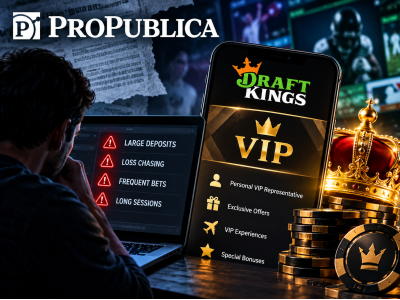
Pearson intentionally copied behaviors that addiction experts, people in recovery, and professional gamblers say are warning signs of problem gambling. He chased losses, made repeated deposits, increased his bets, spent long hours on the site, and bet heavily on unfamiliar events.
DraftKings did send responsible-gambling messages.
But it also made him a VIP.
According to ProPublica, Pearson was formally accepted into the DraftKings VIP program after approximately three weeks and $5,800 in deposits. DraftKings assigned him a personal VIP representative offering individualized opportunities and perks.
This contrast makes the investigation especially important to the broader U.S. gambling debate.
DraftKings maintains that responsible gaming is embedded throughout its business and argues that conclusions should not be drawn from a single account. The company also offers deposit and spending controls, cool-off periods, self-exclusion and other responsible-gambling tools.
Still, the ProPublica experiment raises a tougher question: What happens when both responsible-gambling systems and VIP programs flag the same player at once?
A 10-Week Stress Test of DraftKings' Responsible-Gambling System
Pearson did not attempt to hide what he was doing.He opened the DraftKings account in his own name, linked his debit card, and listed his occupation as a reporter. ProPublica funded the experiment.
With help from specialists, he tried to mimic clear high-risk gambling patterns instead of just betting large sums.
Over the next 10 weeks, his gambling behaviors became more extreme.
The experiment involved chasing losses, making repeated deposits, raising bet sizes, spending longer sessions, and quickly betting on different sports.
DraftKings' systems did react.
DraftKings says Pearson got 32 responsible-gaming notices during the experiment, including messages sent to all customers. Pearson said he received in-app responsible-gaming notifications on 14 out of the 71 days he gambled.
DraftKings Chief Responsible Gaming Officer Lori Kalani told ProPublica that the company has a 51-person responsible-gaming team that manually reviews accounts suspected of problematic behavior.
However, Pearson said that team never reached out to him directly during his experiment.
DraftKings cautioned against extrapolating from one account.
“I just don’t think we should be drawing broad conclusions from, you know, your single account, what you did,” Kalani told ProPublica.That qualification matters. This was a controlled journalistic experiment. This detail is important. The experiment involved just one account and was not a full audit of all DraftKings customers. Arguably the more significant part of the investigation.
From Loss Chasing to DraftKings VIP
After an early period of moderate wagering, Pearson intentionally began chasing losses.According to ProPublica, only weeks into the experiment - and after $5,800 in deposits - DraftKings accepted him into its VIP program.
A personal concierge was assigned to his account.
VIP programs play a big role in online gambling. High-value customers get personalized service, special promotions, hospitality, bonus offers, and direct contact with account reps.
DraftKings describes its VIP and Loyalty operation as providing a “world-class experience” while maintaining a commitment to safe and responsible play.
The ProPublica test shows these goals can conflict.
A player who is valuable to the company might also show signs that should trigger more careful responsible-gambling checks.
So, the key regulatory question may not just be whether operators have responsible-gambling tools.
It’s whether those systems can take priority over business incentives when the same customer triggers both.
The Cool-Off Test Makes the Story More Significant
Pearson eventually took an unmistakable responsible-gambling action himself.
After an intense period of tennis wagering, he entered DraftKings' responsible-gaming center, set limits, and then started a three-day cool-off period. He reported that promotional activity declined, bonus opportunities disappeared and deposit prompts returned to lower default amounts.
But the experiment continued.
After completing the three-day cool-off, Pearson contacted his VIP representative and asked whether depositing a substantial amount could produce an additional incentive.
Less than a week after the cool-off, ProPublica reports that the VIP representative offered Pearson an extra $1,250 in DK Dollars if he deposited $5,000.
The sequence is important.
The responsible-gambling system had just seen one of the clearest signals possible: the customer chose to stop gambling on his own.
Yet soon afterward, the VIP relationship Yet soon after, the VIP program was able to offer a large deposit incentive again.ider the interaction problematic.
DraftKings Says Responsible Gaming Is Embedded Across Its Business
DraftKings strongly rejects the idea that responsible gambling is merely a compliance exercise.In a statement reported by ProPublica, the company said its more than 5,000 employees receive responsible-gaming training annually and described responsible gaming as integral to its long-term sustainability.
Its public responsible-gaming program offers customers tools to establish budgets and limits, initiate cool-off periods and self-exclude.
DraftKings also says it uses technology and customer education to promote healthier gambling behavior.
The timing of the ProPublica investigation is particularly notable because DraftKings announced another expansion of these initiatives on September 14, 2026.
The operator introduced customizable cool-off periods ranging from three to 364 days and expanded its Gamalyze responsible-engagement initiative through a collaboration with Mindway AI.
DraftKings said these initiatives were intended to increase awareness and use of responsible-engagement resources.
This means the ProPublica investigation is less about whether DraftKings has responsible-gambling technology, which it clearly does, and more about how the different parts of its technology work together.
The Bigger Issue: Responsible Gaming Versus Personalization
Modern sportsbook platforms rely increasingly on behavioral data.The same activity stream can potentially power multiple systems simultaneously.
One system may analyze betting frequency, deposits and session duration for responsible-gambling purposes.
Another may calculate customer lifetime value.
A third may determine promotion eligibility.
Another may identify VIP candidates.
And increasingly, more advanced personalization tools can now decide which offer, notification, or market is most likely to get a customer to interact again. From a technology perspective, the important question for the gambling industry heading into 2027 is not whether operators can identify behavioral patterns.
They increasingly can.
The tougher question is which algorithm takes priority when the systems disagree.
Imagine that Player A suddenly increases deposits, begins chasing losses, dramatically extends session duration, and starts wagering on unfamiliar markets.
A responsible-gambling model might interpret those changes as potential risk.
A commercial customer-value model might interpret exactly the same data as increasing engagement.
This is one of the main challenges for managing data-driven gambling.
Only a Minority of DraftKings Players in Massachusetts Were Using Controls
Another important data point in the ProPublica investigation is this.
As of April 2026, just over 8% of active DraftKings customers in Massachusetts were using responsible-gambling tools, according to information a company official provided to state regulators and cited by ProPublica.
DraftKings said adoption was low. Still, this number shows a basic problem with voluntary responsible-gambling systems.
These tools can be advanced and easy to use, but they usually rely on customers choosing to turn them on.
That’s why some responsible-gambling advocates now call for moving from reactive controls to earlier behavioral intervention.
This debate will likely become more important as artificial intelligence makes it easier to monitor behavior closely.
VIP Programs Could Become a Major Regulatory Battleground
VIP treatment used to be linked mostly to land-based casinos, where hosts built personal relationships with top customers.Mobile gambling changes that relationship.
An online sportsbook can now track thousands or even millions of behavioral signals all the time.
Things like deposits, withdrawals, how often someone bets, what they bet on, session length, time of day, responses to promotions, and changes in gambling habits all help build detailed player profiles.
This allows for more personalized offers and experiences, so creates regulatory questions that were much less relevant when gambling primarily happened inside physical casinos.
- Should a player who recently activated a cool-off automatically become temporarily ineligible for VIP incentives?
- Should responsible-gambling risk scores override promotional algorithms?
- Should VIP representatives be able to see responsible-gambling indicators?
- Should substantial deposit bonuses require additional checks following a cool-off?
And should regulators establish mandatory intervention thresholds rather than leaving individual operators to design them?
Those questions could become increasingly important for U.S. regulators during 2027.
Yes. According to ProPublica, Jake Pearson was accepted into DraftKings' VIP program after approximately three weeks and $5,800 in deposits during a 10-week experiment in which he deliberately reproduced behaviors associated with problematic gambling.
Yes. DraftKings told ProPublica that Pearson received 32 responsible-gaming communications during the experiment, including communications distributed to customers generally. Pearson said he received betting-related in-app responsible-gaming notices on 14 of his 71 gambling days.
DraftKings provides budgeting and limit-setting tools, cool-off periods and self-exclusion. In September 2026, the company also announced customizable cool-off periods ranging from three to 364 days and additional responsible-engagement initiatives.


 ...


 ...


 ...
ProPublica Stress-Tests DraftKings’ Responsible-Gambling Controls and Still Gets Made a VIP
Polymarket Takes New York to Federal Court